

Why formulas do not solve games
Why allocation formulas matter, but incentives and behaviour decide what happens next.

Funding formulas look technical. They feel objective. They use numbers, weights, datasets, regression models and official language.
But formulas do not remove politics. They often concentrate it. Their complexity can obfuscate understanding.
New Zealand has seen this before with the Population-Based Funding Formula, which was used to distribute District Health Board funding. A New Zealand Medical Journal article analysed 487 newspaper articles about that formula between 2003 and 2016. The formula became a public flashpoint, especially in the South Island. A central theme was dissatisfaction with allocations and concern about transparency.
That should not surprise anyone.
Health officials, perhaps unwisely, responded to emphasise the formula’s technical legitimacy and chide Canterbury District Health Board leaders, for being “special", rather than listen and respond to the actual concerns.
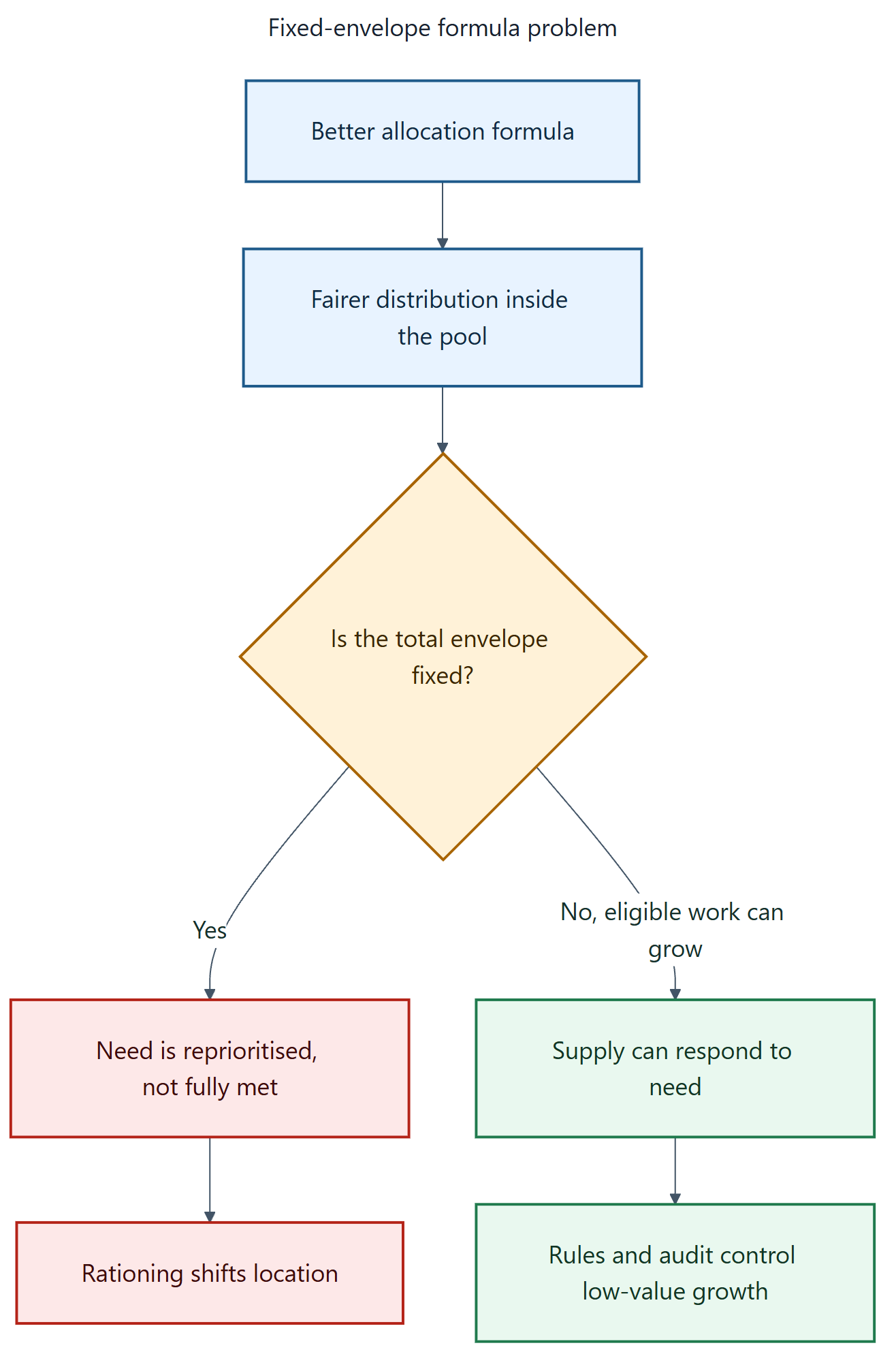
Figure 4. A better allocation formula can distribute a fixed pool more fairly. It does not, by itself, remove the supply constraint.
To clarify: Formula reweighting is necessary. The argument is not that formulas do not matter. It is that formulas alone cannot settle questions of supply, accountability, gaming, and unmet need. Nor are they effective at quelling community sentiment.
A funding formula is a way of deciding shares. Once shares are at stake, everyone has a reason to argue that the formula misses something important.
Rurality. Deprivation. Age. Ethnicity. Unmet need. Complexity. Diseconomies of scale. Transport. Workforce costs. Growth. Decline. Fixed infrastructure. Historical underfunding. Future demand.
All of those things matter.
But the more variables you add, the more the debate becomes a contest about weights. One group says deprivation is underweighted. Another says rurality is underweighted. Another says age is underweighted. Another says historical utilisation bakes in past access failure. Another says the model punishes efficient providers. Another says it rewards providers who generate activity. Then an opaque actuarial process is undertaken that in reality few decision-makers, let alone consumers and clinicians, understand.
That does not mean formulas are useless. They are necessary. If public money is being allocated across populations, there must be some logic to the allocation.
But a formula can only answer one kind of question:
How should a funding pool be distributed?
It cannot fully answer a different question:
Should the pool itself be capped in a way that suppresses clinically useful activity?
That is the distinction I think matters in primary care. I've only come across one New Zealand politician who has asked that question: then Minister for Health, Simon Power.
The current capitation reweighting work is sensible. The Ministry of Health says the old formula was based on how people used general practice in the late 1990s. Since then New Zealand has changed: more long-term conditions, more multimorbidity, more treatment options, more complexity managed in the community, and different rural and deprivation patterns. A ~30 year delay in revision does itself say something about the machinery of government in NZ.
So yes, the formula should change.
But reweighting capitation does not solve the marginal-supply problem by itself. Capitation’s dominance in our funding system, perpetuates the marginal supply problem.
It can make funding distribution fairer across practices. It can move more funding toward practices with higher-need enrolled populations. It can reduce some inequity. Those are good things.
But if the overall architecture remains heavily capped, the next appointment may still be weakly funded.
This is why I worry about “missing the wood from the trees”:
The tree is the formula. The wood is the system game.
The formula asks whether Practice A should get more than Practice B.
The game asks whether either practice can afford to provide the next clinically needed contact.
The formula asks whether rurality should have a higher weight.
The game asks whether a rural patient can actually see someone in person.
The formula asks whether multimorbidity is included.
The game asks whether complex patients get enough time, follow-up and coordination.
The formula asks whether deprivation is measured properly.
The game asks whether people in deprived communities are rationed by cost, waiting time or closed books.
The formula asks whether the model is fair.
The game asks whether the system grows in the right place.
That is why my proposal is not to stop capitation reweighting. It is to add another layer.
Keep improving the formula.
But do not expect the formula to do the job of a funding architecture.
The architecture should include:
capitation for continuity and population accountability;
uncapped scheduled fee-for-service for eligible primary medical contacts;
targeted funding for priority programmes;
place-based accountability to prevent cherry-picking;
audit and clinical governance.
That is more complicated than a formula. But the system is complicated.
The danger is that we spend years arguing over capitation weights while the real supply constraint remains intact.
A better formula may distribute scarcity more fairly. It will not remove the scarcity.
The trap in formula politics
In plain English: a formula can divide money, but it cannot remove incentives. Once the money is divided, organisations still respond to pressure, visibility and risk.
Formula fights are seductive because they look technical. Everyone can point to a variable. Age. Deprivation. Rurality. Ethnicity. Multimorbidity. Workforce cost. Practice size. Travel time.
All of those variables matter. But the deeper problem is that no formula can carry all the political expectations placed on it. If the total envelope is fixed, every added weight creates a redistribution. Someone gains. Someone loses. The debate then becomes a fight over the denominator, the coefficients and the evidence base.
What would change my mind?
I would be less convinced if capitation reweighting alone materially improved access, reduced closed books, protected rural in-person care and reduced avoidable hospital demand. That is testable: the data exists, accessing it and using it is another story altogether.
Deep dive (optional, not required reading): I’ve included the fuller explanation, modelling notes and source list in the appendix below.
Note: This series is exploratory policy analysis. It is not a party-political argument, not a position sponsored by an external body, not a claim that any single funding model is perfect, and not a calibrated prediction of savings. The central question is whether New Zealand's current funding architecture lets lower-cost upstream care expand safely before need becomes hospital demand.
Useful links
Deep dive appendix for Post 04: Why formulas do not solve games
This appendix is supporting material for the public post. It carries the longer explanation, sources and assumptions for readers who want the detail.
The game underneath the policy
Every post in this series is built around a game. A game is simply a situation where each player responds to the rules and to what the other players do.
Table summary: Player | What they are trying to avoid | What they may do under pressure
Patients: What they are trying to avoid: Delay, cost, uncertainty, worsening illness; What they may do under pressure: Wait, pay, delay, use telehealth, call ambulance, go to hospital
Providers: What they are trying to avoid: Unfunded work, burnout, financial risk; What they may do under pressure: Close books, shorten appointments, raise fees, limit extra activity
Health New Zealand: What they are trying to avoid: Visible failure, deficits, hospital pressure; What they may do under pressure: Prioritise urgent hospital pressures
Primary Health Organisations or locality bodies: What they are trying to avoid: Loss of role, loss of funding, accountability risk; What they may do under pressure: Defend functions, manage pass-through, shape provider incentives
Accident Compensation Corporation: What they are trying to avoid: Uncontrolled claims cost, poor outcomes; What they may do under pressure: Tighten payment rules or shift toward commissioning
Ministers: What they are trying to avoid: Publicly visible service failure; What they may do under pressure: Fund the pressure people can see
This is why an apparently technical funding issue becomes a political economy issue very quickly.
How this fits the hybrid model
The hybrid model has five parts:
capitation for continuity and population responsibility;
uncapped scheduled fee-for-service for eligible primary medical activity;
place-based accountability so providers cannot simply cherry-pick easy activity;
scope-enabled supply so safe care can be generated by the right provider, not only the traditional provider;
data, audit and top-tier key performance indicators so the system can see access failure before it becomes hospital pressure.
The model is deliberately not a blank cheque. The point is to remove the global cap on eligible primary medical activity, while keeping item prices, clinical eligibility, provider scope, documentation, audit, co-payment protections and place accountability.
What this adds to the modelling
In the demonstrative model, this post corresponds to one or more component games. The model asks what happens if the system stays in the current equilibrium, and what happens if the policy architecture shifts the equilibrium.
The model does not claim, yet, that the preferred architecture will reduce emergency department presentations by a precise number. That would require linked data, calibration and validation. What the model does show is the logic of the mechanism and the assumptions that need to be tested.
The most important empirical tests are:
whether scheduled activity payments increase safe primary care supply;
whether unmet primary care need flows into urgent care, ambulance and hospitals;
whether Accident Compensation Corporation activity payments help sustain local primary care capacity;
whether Primary Health Organisation payment arrangements create material pass-through, transparency or entry barriers;
whether scope-enabled providers can expand supply safely and equitably.
Sources and further reading
Appendix note: Supporting material for readers who want the longer explanation, sources and assumptions.